
BIGBEAR
PHARMACEUTICALS
Low incidence of peripheral edema.
Low hepatotoxicity.

 AuthenticGuaranteeFast DeliveryPrivacy
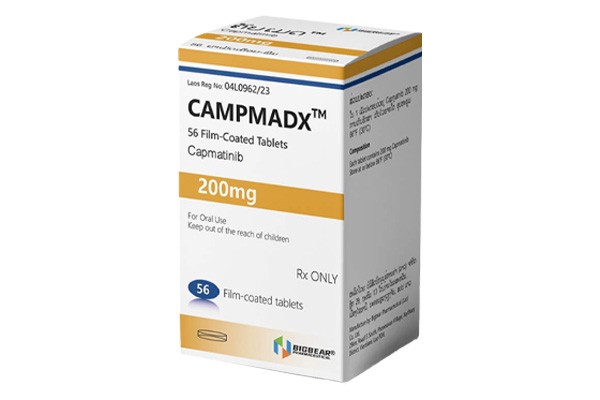
 Capmatinib is a small-molecule, adenosine triphosphate (ATP)-competitive, reversible MET receptor tyrosine kinase inhibitor.
First granted accelerated approval by the FDA in 2020, capmatinib has since received full approval in the United States (for both treatment-naïve and previously treated patients), the European Union (for previously treated patients), and Japan (for both treatment-naïve and previously treated patients). It is approved for marketing in more than 50 countries worldwide for the treatment of adult patients with metastatic non-small cell lung cancer (NSCLC) harboring MET exon 14 skipping mutations.
Prior to initiation of treatment with this product, the presence of a MET exon 14 skipping mutation must be confirmed using a validated, sufficiently validated detection method.
The recommended dosage of this product is 400 mg, administered orally twice daily, with or without food.
In the global study A2201 (GEOMETRY mono-1), of the 373 patients included, 61% were aged ≥ 65 years and 18% were aged ≥ 75 years. No overall differences in safety or efficacy were observed between these patients and younger patients.
Population pharmacokinetic analysis showed no clinically meaningful effects of age, gender, race, or body weight on the systemic exposure of capmatinib.
Based on a population pharmacokinetic analysis encompassing 207 patients with normal renal function (creatinine clearance [CLcr] ≥ 90 mL/min), 200 patients with mild renal impairment (CLcr 60–89 mL/min), and 94 patients with moderate renal impairment (CLcr 30–59 mL/min), mild or moderate renal impairment had no clinically meaningful impact on the exposure to capmatinib. This product has not been studied in patients with severe renal impairment (CLcr 15–29 mL/min).
A study was conducted to evaluate a single 200 mg dose of capmatinib in non-cancer subjects with varying degrees of hepatic impairment as classified by the Child-Pugh scale. Compared to subjects with normal hepatic function (N = 9), the geometric mean systemic exposure (AUCinf) of capmatinib was approximately 23% lower in subjects with mild hepatic impairment (N = 6) and 9% lower in those with moderate hepatic impairment (N = 8), while it was approximately 24% higher in subjects with severe hepatic impairment (N = 6). The Cmax was approximately 28% lower in subjects with mild hepatic impairment and 17% lower in those with moderate hepatic impairment, whereas Cmax in subjects with severe hepatic impairment (2% increase) was similar to that in subjects with normal hepatic function. Mild, moderate, or severe hepatic impairment had no clinically meaningful effect on the exposure to capmatinib.
The safety profile of capmatinib was summarized from the global pivotal Phase 2 trial A2201 (GEOMETRY mono-1). Safety was evaluated in all cohorts (N = 373) of patients with locally advanced or metastatic NSCLC, regardless of prior therapy or MET dysregulation status (mutation and/or amplification). The median duration of exposure to capmatinib across all cohorts was 17.9 weeks (range: 0.4–281.0 weeks). Among patients treated with capmatinib, 36.7% had exposure for at least 6 months, and 21.7% had exposure for at least 1 year.
Serious adverse events (AEs), regardless of causality, were reported in 198 patients (53.1%) who received capmatinib. Serious AEs occurring in >2% of patients (regardless of causality) included dyspnea (6.7%), infectious pneumonia (5.9%), pleural effusion (4.3%), general physical deterioration (2.9%), and vomiting (2.4%).
Fourteen patients (3.8%) died during treatment with capmatinib from causes other than the underlying malignancy. One death was confirmed as treatment-related: pulmonary inflammation.
Permanent discontinuation of capmatinib due to AEs (regardless of causality) was reported in 65 patients (17.4%). The most common AEs (≥0.5%) leading to permanent discontinuation were peripheral edema (2.1%), pulmonary inflammation (1.6%), fatigue (1.3%), elevated ALT (0.8%), elevated AST (0.8%), elevated serum creatinine (0.8%), nausea (0.8%), infectious pneumonia (0.8%), vomiting (0.8%), elevated bilirubin (0.5%), breast cancer (0.5%), heart failure (0.5%), general physical deterioration (0.5%), interstitial lung disease (0.5%), elevated lipase (0.5%), organizing pneumonia (0.5%), and pleural effusion (0.5%).
Treatment interruption due to AEs (regardless of causality) was reported in 211 patients (56.6%) who received capmatinib. AEs occurring in >2% of patients requiring treatment interruption (regardless of causality) included peripheral edema (11.0%), elevated serum creatinine (8.3%), nausea (6.2%), elevated lipase (5.6%), vomiting (5.6%), elevated ALT (4.8%), dyspnea (4.6%), infectious pneumonia (4.3%), elevated amylase (3.8%), elevated AST (3.2%), asthenia (2.4%), and elevated bilirubin (2.1%).
Dose reduction due to AEs (regardless of causality) was reported in 98 patients (26.3%) who received capmatinib. AEs occurring in >2% of patients requiring dose reduction (regardless of causality) included peripheral edema (9.1%), elevated ALT (3.2%), and elevated serum creatinine (2.1%).
The most common adverse drug reactions (ADRs) of all grades occurring in ≥20% of patients treated with capmatinib were peripheral edema, nausea, fatigue, vomiting, elevated serum creatinine, dyspnea, and decreased appetite. The most common Grade 3 or 4 ADRs occurring in ≥5% of patients treated with capmatinib were peripheral edema, fatigue, dyspnea, elevated ALT, and elevated lipase.
Patients with a hypersensitivity to any component of this product, those with severe hepatic or renal impairment, and pregnant or lactating women (who must implement contraceptive measures).
Fatal cases of ILD/pneumonitis have occurred in patients treated with this drug. Monitor for new or worsening pulmonary symptoms indicative of ILD/pneumonitis (e.g., dyspnea, cough, fever). If other potential etiologies for ILD/pneumonitis are ruled out, permanently discontinue this drug in patients with suspected ILD/pneumonitis immediately.
Prior to initiation of treatment with this drug, liver function tests (including ALT, AST, and total bilirubin) should be monitored every 2 weeks for the first 3 months of therapy, followed by monthly monitoring or as clinically indicated. Perform more frequent testing of transaminases or bilirubin in patients who develop abnormalities. Permanently discontinue, reduce the dose, or interrupt this drug based on the severity of the adverse reaction.
Based on findings from animal studies, this drug has a potential risk of phototoxic reactions. In GEOMETRY mono-1, patients were advised to take precautions against ultraviolet (UV) radiation during treatment with this drug, such as using sunscreen or wearing protective clothing. Patients are also recommended to limit direct exposure to UV radiation while taking this drug.
Based on findings from animal studies and the drug’s mechanism of action, administration of this drug to pregnant women can cause fetal harm. Advise pregnant women of the potential risk to the fetus. Instruct female patients of reproductive potential and their partners to use effective contraception during treatment with this drug and for 1 week after the last dose.
If any issues arise, please contact us immediately.
Email:haiousales@gmail.com

Copyright2024@ BIGBEAR All right reserved BIGBEAR


