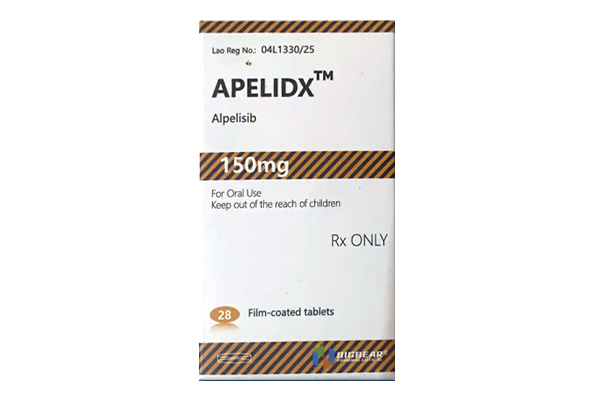
Alpelisib Special Considerations for Specific Populations
1. Pregnancy
May cause fetal harm.
2. Lactation
It is unknown whether alpelisib is excreted into human milk or affects the breastfed infant or milk production. Discontinue breastfeeding during treatment and for ≥1 week after the last dose.
3. Females and Males of Reproductive Potential
(1) Females of reproductive potential should use effective contraception during treatment and for ≥1 week after the last dose.
(2) Male partners of such females should use condoms and effective contraception during treatment and for ≥1 week after the last dose.
(3) Animal study results suggest that alpelisib may impair fertility in males and females.
4. Pediatric Use
(1) Safety and efficacy in breast cancer have not been established.
(2) Safety and efficacy in pediatric PROS patients<2 years="" of="" age="" have="" not="" been="" established.="">
5. Geriatric Use
(1) Breast cancer patients ≥65 years of age: Efficacy was not overall different compared to younger adults; however, the incidence of grade 3 or 4 hyperglycemia was increased in elderly patients.
(2) Breast cancer patients ≥75 years of age: Experience is insufficient to determine whether efficacy and safety are similar to younger adults; however, the incidence of hyperglycemia (including grade 3–4 hyperglycemia) was increased in patients ≥75 years.
(3) In the EPIK-P1 study evaluating alpelisib in PROS patients, no adults ≥65 years of age were enrolled.
6. Hepatic Impairment
The pharmacokinetics of alpelisib are not altered in patients with hepatic impairment (Child‑Pugh A, B, or C).
7. Renal Impairment
The pharmacokinetics of alpelisib are not altered in patients with mild to moderate renal impairment (Clcr 30–89 mL/min). The effect of severe renal impairment (Clcr<30 ml="">
Common Adverse Reactions of Alpelisib
1. Adverse Reactions Reported in ≥20% of Breast Cancer Patients
Increased blood glucose, increased serum creatinine, diarrhea, rash, decreased lymphocyte count, increased gamma‑glutamyl transferase, nausea, increased alanine aminotransferase, fatigue, decreased hemoglobin, increased lipase, decreased appetite, stomatitis, vomiting, weight loss, decreased calcium, decreased glucose, prolonged activated partial thromboplastin time, alopecia.
2. Adverse Reactions Reported in ≥10% of PROS Patients
Diarrhea, stomatitis, hyperglycemia.
Drug Interactions of Alpelisib
1. Metabolism
Primarily metabolized by chemical and enzymatic hydrolysis, and secondarily by CYP3A4. In vitro studies show inhibition of CYP3A4; induction of CYP2B6, 2C9, and 3A4 isoenzymes. In vitro studies show inhibition of P‑glycoprotein (P‑gp); inhibition of breast cancer resistance protein (BCRP), multidrug resistance protein 2 (MRP2), bile salt export pump (BSEP), organic anion transporting polypeptide (OATP) 1B1, OATP1B3, organic anion transporter (OAT) 1, OAT3, organic cation transporter (OCT) 1, OCT2, multidrug and toxin extrusion (MATE) transporters 1 and 2‑K is unlikely. In vitro studies show that it is a substrate of BCRP.
2. Drugs Affecting Hepatic Microsomal Enzymes
Strong CYP3A4 inducers: May reduce systemic exposure of alpelisib, decreasing its efficacy. Avoid concomitant use and consider alternative drugs with no or minimal CYP3A4 induction potential.
3. Drugs Metabolized by Hepatic Microsomal Enzymes
CYP substrates: No dose adjustment is required when alpelisib is coadministered with substrates of CYP3A4, CYP2C8, CYP2C9, CYP2C19, and CYP2B6, because no clinically significant pharmacokinetic interactions are expected.
4. Drugs Affecting Breast Cancer Resistance Protein
BCRP inhibitors: May increase systemic exposure of alpelisib, increasing the risk of toxicity. Avoid concomitant use. If concomitant use cannot be avoided, monitor for adverse reactions.
5. Drugs Affecting Gastric Acidity
Drugs that increase upper gastrointestinal pH: May reduce the solubility of alpelisib, leading to decreased plasma alpelisib concentrations. Because alpelisib is taken with food, and food has a more significant effect on its solubility than gastric pH, concomitant use is permissible.