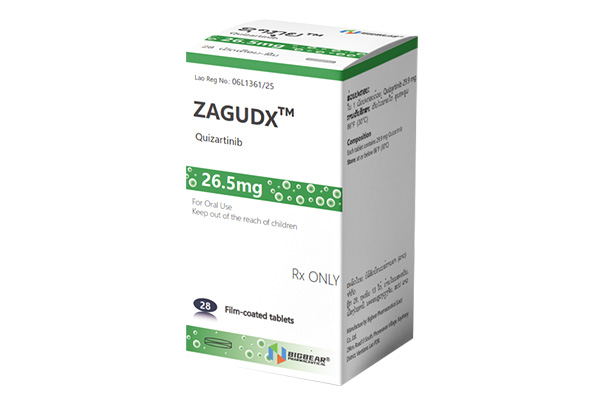
Quizartinib is administered orally. The specific dosage is not fixed and varies over time based on the phase of treatment, electrocardiogram (ECG) results, and concomitant medications.
Starting Dosage
1. Induction Phase: 35.4 mg orally once daily. Under the 7+3 regimen, initiate treatment on Day 8 and administer from Days 8 through 21.
2. If switching to the 5+2 regimen in the second induction cycle: The administration window is Days 6 through 19. Induction is limited to a maximum of 2 cycles.
3. Consolidation Phase: 35.4 mg orally once daily, administered on Days 6 through 19 of each 28-day cycle, for up to 4 cycles.
4. Maintenance Phase: 26.5 mg orally once daily on Days 1 through 14 of Cycle 1; if QTcF is less than or equal to 450 ms, increase to 53 mg once daily starting on Day 15.
Precautions: If QTcF exceeded 500 ms during the induction or consolidation phase, maintain at 26.5 mg during the maintenance phase without dose escalation. Administer for a maximum of 2 induction cycles, 4 consolidation cycles, and 36 maintenance cycles, or until disease progression or unacceptable toxicity.
Dose Selection
Please select product strengths flexibly according to the daily dosage. The 17.7 mg tablets are used during the induction and consolidation phases, and the 26.5 mg tablets are used during the maintenance phase. The printing on the medication boxes differs; do not mix tablets between phases.
Precautions: Quizartinib tablets are labeled as 17.7 mg and 26.5 mg, whereas the tablet core actually contains 20 mg and 30 mg of quizartinib dihydrochloride, respectively. This is not a labeling error; the latter represents the amount in salt form, while the former is calculated based on the free base equivalent.
Prerequisites for Administration
1. QTcF must be less than or equal to 450 ms prior to initiating treatment. Dose escalation is not permitted if QTcF is greater than 450 ms.
2. Dose escalation occurs only on Day 15 of Cycle 1 during the maintenance phase, conditioned upon a QTcF of less than or equal to 450 ms.
Dose Reduction Steps
Total daily dose reduction ladder: 53 mg → 35.4 mg → 26.5 mg. Interrupt administration if a dose reduction is required while already at 26.5 mg. Interrupt administration directly if a dose reduction is required while at 17.7 mg.
1. QTcF 450 to 480 ms (Grade 1): Do not interrupt administration; continue with dose reduction following the reduction ladder.
2. QTcF 481 to 500 ms (Grade 2): Do not interrupt administration; reduce dose following the reduction ladder; if QTcF decreases to below 450 ms in the next cycle, the prior dose may be resumed.
3. QTcF greater than 500 ms (Grade 3): Interrupt treatment; resume at the reduced dose once QTcF decreases to below 450 ms.
4. Recurrent QTcF greater than 500 ms, after standard dose reduction and correction of other risk factors: Permanently discontinue.
Dose Adjustments for Adverse Reactions
1. Torsades de pointes, polymorphic ventricular tachycardia, or signs/symptoms of life-threatening arrhythmia: Permanently discontinue.
2. Grade 3 or 4 non-hematologic adverse reactions: Interrupt treatment; resume at the original dose once resolved to Grade 1 or lower, or resume at a reduced dose once resolved to Grade 2; discontinue if persistent for more than 28 days.
3. Grade 3 or 4 hypokalemia (less than 3 mmol/L) or hypomagnesemia (less than 0.4 mmol/L or less than 0.9 mg/dL): Interrupt treatment and correct electrolytes; resume at the original dose once improved to Grade 2 or lower and asymptomatic.
4. Grade 4 neutropenia or thrombocytopenia occurring after achieving remission: Reduce dose according to the reduction ladder, and a bone marrow evaluation is recommended.
Dose Adjustments for Concomitant Use with Strong CYP3A Inhibitors
1. Current dose 53 mg → reduce to 26.5 mg.
2. Current dose 35.4 mg → reduce to 17.7 mg.
3. Current dose 26.5 mg → reduce to 17.7 mg.
4. Current dose already at 17.7 mg → interrupt quizartinib during strong CYP3A inhibitor co-administration.
5. Resume the pre-inhibitor dose after the inhibitor has been discontinued for at least 5 elimination half-lives.
Administration Instructions
1. Take at approximately the same time each day; with or without food. Swallow tablets whole; do not cut, crush, or chew.
2. In case of vomiting after taking a dose: Do not take a replacement dose; wait until the next scheduled dose.
3. In case of a missed dose: Take as soon as possible on the same day, and resume the regular schedule the following day; do not take two doses on the same day.
4. Storage conditions: Store at 20°C to 25°C, with excursions permitted between 15°C and 30°C.