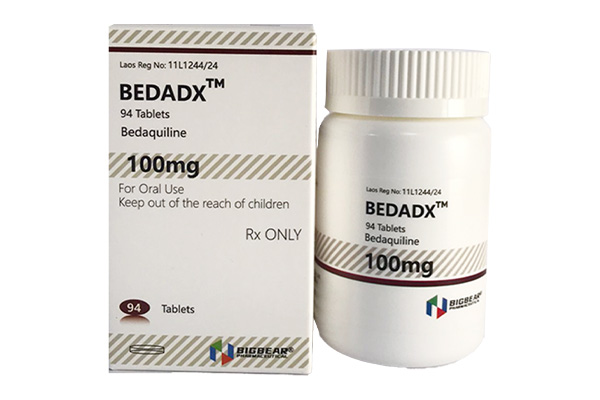
Amidst the dual challenges of drug accessibility and prohibitive costs confronting global multidrug-resistant tuberculosis (MDR-TB) treatment, the bedaquiline generic launched by Lao Big Bear Pharmaceutical, leveraging its significant price advantage and progressively improved access mechanisms, is quietly emerging as a pivotal variable that breaks the monopoly of international giants and reshapes the landscape of anti-TB drug markets.
Is there a Lao generic version of Bedaquiline?
Yes, there is a Lao generic version of bedaquiline. The Lao Big Bear version of bedaquiline is available in a specification of 100mg*94 tablets per box. For further inquiries, we recommend consulting a professional customer service representative.
Indications and Clinical Positioning of Bedaquiline
Bedaquiline (generic name: bedaquiline) belongs to the diarylquinoline class of antimycobacterial agents, with a unique mechanism of action that exerts bactericidal and sterilizing activity by inhibiting the ATP synthase of Mycobacterium tuberculosis. This product is strictly indicated for use in adult patients (aged ≥18 years) with pulmonary multidrug-resistant tuberculosis (MDR-TB) as part of a combination regimen, and only when an effective treatment regimen cannot be constructed otherwise, it is reserved as a salvage drug. This restricted indication is based on its clinical benefit-risk assessment, aiming to preserve this novel target drug resource for the most challenging drug-resistant TB cases. In clinical decision-making, it must be clear that bedaquiline is not indicated for latent tuberculosis infection, as the bacterial metabolism is inactive in that state and the drug's bactericidal efficacy cannot be fully realized; it is also not indicated for extrapulmonary tuberculosis lesions (e.g., lymph nodes, bone, central nervous system) due to insufficient evidence on tissue penetration and local concentrations; nor is it indicated for drug-susceptible tuberculosis, to avoid unnecessary patient exposure to potential risks and to accelerate resistance development. Before initiating therapy, MDR-TB must be confirmed by drug susceptibility testing or molecular diagnostic methods, and a comprehensive assessment of prior medication history, resistance profile, and overall patient condition is required to ensure that bedaquiline plays an irreplaceable supplementary role in the overall combination regimen. This restrictive wording of the indication also reminds clinicians that this product is not a first-line option for MDR-TB, but rather a "reserved weapon" after rigorous selection, and its use should follow international and national guidelines for drug-resistant TB treatment, and be prudently initiated on the basis of multidisciplinary consultation.
Dosage and Administration of Bedaquiline
The dosing regimen for bedaquiline is divided into two phases: an intensive loading phase and a maintenance phase, which must be strictly followed in terms of timing and dosage specifications. The loading phase is the first 2 weeks (i.e., days 1–14), with a once-daily oral dose of 400mg (equivalent to 4 tablets of 100mg) to be taken with food to enhance bioavailability and reduce gastrointestinal irritation; the maintenance phase covers the subsequent 22 weeks, with a dose of 200mg (i.e., 2 tablets) taken orally three times per week, with each dose separated by at least 48 hours (e.g., Monday, Wednesday, Friday), for a total treatment course of 24 weeks. The tablets should be swallowed whole, not crushed, chewed, or dissolved, to maintain the integrity of the sustained-release matrix and stable drug release profile. The requirement of taking with food is not only about absorption efficiency; studies show that a high-fat meal can increase exposure by approximately 2-fold, so consistent eating habits should be maintained to avoid fluctuating plasma concentrations from fasting administration. If a dose is missed during the loading phase, it should be taken as soon as possible, but if it is close to the next scheduled dose, skip it; during the maintenance phase, if a dose is missed, skip it and resume the regular schedule, without doubling the dose. No dose adjustment is required based on body weight, but patient tolerance to the dose, especially during the high-exposure loading phase, should be closely monitored. This entire regimen is established based on global phase III clinical trial data, which ensures antibacterial efficacy while keeping the risks of QT prolongation and hepatotoxicity within acceptable limits. In clinical practice, it is recommended to use pillboxes or alarms to aid adherence, and to count remaining tablets at each follow-up visit, documenting actual intake, as irregular adherence not only undermines efficacy but also is a critical factor in provoking resistance mutations; therefore, educating patients on the importance of regular and quantitative dosing is a prerequisite for treatment success.