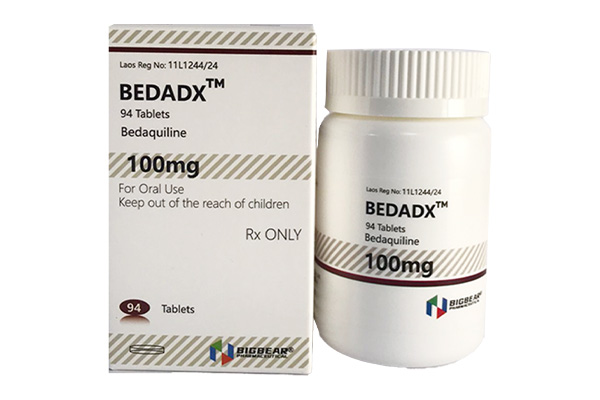
Leveraging Laos' increasingly mature generic pharmaceutical industrial system, the bedaquiline produced by DaXiong Pharmaceutical has established a dual reputation for "high cost-effectiveness" and "reliable quality" in the global anti-infective drug field, backed by a clear WHO prequalification (or equivalent international standard) compliance pathway and a stable active pharmaceutical ingredient supply chain.
How much does Lao DaXiong version bedaquiline cost?
The Lao DaXiong version of bedaquiline is available in a strength of 100mg*94 tablets per box, priced at approximately $98. The actual selling price may be influenced by various factors and should be confirmed at the point of purchase.
Adverse reaction profile and clinical management of bedaquiline
Based on pivotal clinical trials and long-term safety data, the most common adverse reactions (incidence ≥10%) during SIRTURO therapy are nausea, arthralgia, and headache. These symptoms are mostly mild to moderate and predominantly occur during the loading phase. Nausea can be alleviated by taking the drug with food; if persistent, antiemetics or divided doses with meals (ensuring the tablet is swallowed whole) may be considered. Arthralgia is non-inflammatory, commonly affecting large joints, and can be managed symptomatically with paracetamol or NSAIDs, while monitoring for drug-drug interactions. Headache, often tension-type or vascular, may be temporarily treated with analgesics and adequate hydration. In addition, hemoptysis and chest pain were observed more frequently in the SIRTURO group than in the placebo group at an incidence ≥10%. These two events require cautious interpretation — hemoptysis may arise from erosive changes in tuberculous lesions or rupture of vessels within cavities, or possibly drug-related coagulation effects; chest pain warrants exclusion of cardiac causes (e.g., QT prolongation‑related myocardial ischemia) or pleural involvement. Clinically, these should not be simply attributed to the drug; instead, imaging (chest CT), electrocardiography, and coagulation tests should be performed to differentiate disease progression, superinfection, or adverse drug reactions. Other adverse reactions occurring at 1%–10% include elevated transaminases, decreased appetite, dizziness, rash, and back pain, which usually resolve spontaneously or with symptomatic treatment. Particular attention should be paid to rare but serious adverse drug reactions, including severe hepatotoxicity, ventricular arrhythmias, and photosensitivity dermatitis; for the latter two, patients should be advised to avoid intense sunlight and use sun protection. Since MDR-TB patients often receive multiple second-line drugs (e.g., cycloserine, prothionamide, aminoglycosides), attribution of adverse events is complex. It is recommended to maintain an adverse event log, recording onset time, severity, interventions, and outcomes for each event, to facilitate timely adjustment of combination regimens and balance efficacy with tolerability.
Drug interactions and special population considerations for bedaquiline
SIRTURO is primarily metabolized via the hepatic CYP3A4 enzyme system; therefore, co-administration with strong inducers or strong inhibitors of CYP3A4 can significantly alter its plasma concentrations, affecting efficacy or toxicity. Concomitant use with systemic strong CYP3A4 inducers (e.g., rifampicin, rifapentine, carbamazepine, phenytoin, St. John's wort extract, etc.) must be strictly avoided, as induction can reduce bedaquiline exposure by more than 50%, leading to treatment failure and increased risk of resistance; if unavoidable, consider modifying the anti-TB regimen or using non-inducing alternatives. Concurrent use with systemic strong CYP3A4 inhibitors (e.g., ketoconazole, itraconazole, clarithromycin, erythromycin, protease inhibitors, grapefruit juice, etc.) for more than 14 consecutive days should be avoided unless the expected benefit clearly outweighs the potential risk, because inhibition can increase bedaquiline AUC by 2‑ to 3‑fold, significantly raising the incidence of QT prolongation and hepatotoxicity; if clinically necessary, close ECG and liver enzyme monitoring is required, and consideration may be given to shortening the loading phase or reducing the dose (though no formal dose adjustment regimen exists).